Right pinyin.
Out loud.
In any script.
A Chinese worksheet in about ten seconds. Readings that fit the word, every character tappable to hear, and all 11,000 HSK words built in.
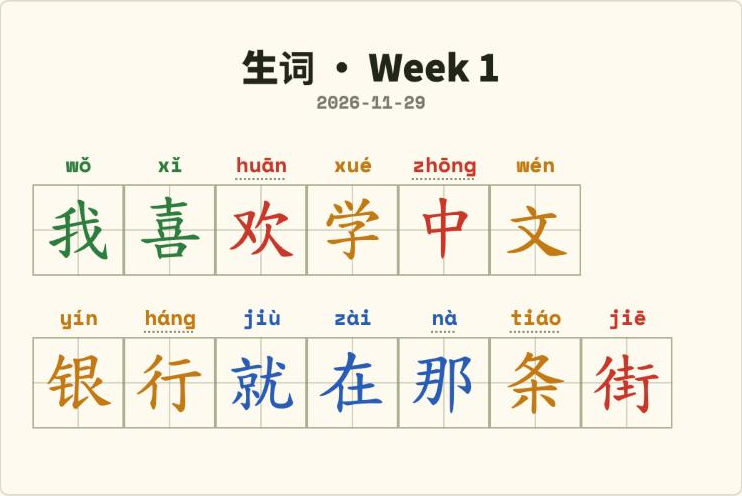
When a character has more than one pronunciation, PING! IN looks at the whole word, so each one is printed with the reading that belongs to it. Tap it to choose a different one. This works for every character that has more than one reading.
Two worksheets, one box to type in
What you see on screen is what prints. These are real sheets.
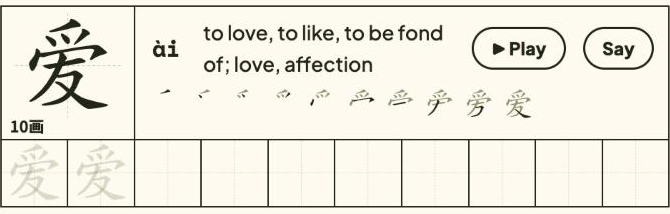

Start from an HSK level
Pick a level. The words drop in with their readings and meanings.
One word, three scripts
Switching changes how the sheet prints, never what you typed.
- Simplified
- Traditional
- Zhuyin 注音
Free to use. Cheap to keep.
Free on screen, always. You pay for more paper.
Open sheet
- Use it on screen as much as you like
- Tap any character to hear it; play a whole line
- Simplified, traditional and Zhuyin 注音
- The full HSK 1–9 vocabulary, 11,000 words
- Tone colours and stroke order
- Download 2 pinyin worksheets a day, 50 characters each
- Download 1 practice worksheet a day, 8 characters
Pro
- Download as many worksheets as you like
- No getpingin.com line in the footer
- Up to 500 characters a worksheet
- Watch the stroke order animate
- Slow speech, for dictation practice
- Save worksheets by name and open them again later
- Line notes — an editable translation under each line, filled in for you from the HSK meanings
- Paper sizes A4, Letter and B5
Or pay $1.80 a month instead.
Questions
Is it really free?
Yes. You can use it on screen as much as you like, with no account. On the free plan you can download 2 reading worksheets a day, of up to 50 characters each, and 1 writing worksheet a day, of up to 8 characters. Pro removes those limits for $19 a year.
How does it choose the right reading?
Many Chinese characters have more than one pronunciation. PING! IN looks at the whole word rather than each character on its own, so the character 行 is read háng in 银行 (bank) and xíng in 行李 (luggage). If more than one reading is still possible, the reading is shown with a dotted underline and you can tap it to choose another. This works for every character that has more than one reading.
Why does 朋友 show péngyou and not péngyǒu?
Both are right, in different standards. HSK writes 朋友 as péngyou; Taiwanese Mandarin writes péngyǒu. A Tone style setting prints the whole worksheet either way, in both tools.
Can I print traditional characters, or Zhuyin 注音?
Yes. Simplified characters are the default. One switch converts the whole worksheet to traditional characters, and it detects which of the two you typed. The Phonetic setting prints Zhuyin 注音 (bopomofo, the phonetic script taught in Taiwan) in place of Pinyin.
Can I save a worksheet and come back to it?
Yes. Give it a name in the Name box, press Save, and it appears in the Saved worksheets list. Saved worksheets are kept in your own browser on this device, so they do not follow you to another computer and clearing your browsing data removes them.
Where do the HSK word lists come from?
They are the New HSK (HSK 3.0) vocabulary lists, all nine levels, 11,000 words in total. Levels 1 to 6 include an English meaning for each word; levels 7 to 9 did not come with English, so those meanings are filled in from CC-CEDICT, a free Chinese-English dictionary, under its CC BY-SA 4.0 licence.
Which voices does it use?
Mandarin only: Mainland Mandarin 普通话 by default, or Taiwanese Mandarin 台灣華語. The audio uses the voices already on your device, so it costs nothing and keeps working after the page has loaded. Slow mode reads more slowly, for dictation.
Can I use the worksheets with my class?
Yes, including photocopying them for your students. Worksheets downloaded on the free plan carry a small getpingin.com line in the footer. Pro removes it.